ISO 17025 vs ISO 9001: Key Differences and Practical Tips
6 October 2023
ISO 17025 vs ISO 9001 is a common comparison for organizations with testing or calibration laboratories. Both standards define requirements for quality, but they serve fundamentally different purposes.
ISO 9001 is a quality management system (QMS) standard. Any organization can pursue certification to improve processes, customer satisfaction, and operational efficiency.
ISO 17025 is an accreditation standard for testing and calibration laboratories. It demonstrates technical competence to produce valid and reliable results.
In this guide, we explain the differences, help you decide which applies to your organization, and clarify what each standard actually requires.

What is ISO 9001?
ISO 9001 is the world's most widely adopted quality management standard. Published by the International Organization for Standardization (ISO), it provides a framework for any organization to build an effective Quality Management System (QMS) – regardless of industry or size. See our detailed guide: "What Is ISO 9001?".
Key facts:
Current version: ISO 9001:2015
Over 1.4 million certified organizations worldwide
Focus: customer satisfaction, process efficiency, risk-based thinking, continual improvement
ISO 9001 certification signals to customers that your company delivers consistent quality. It is often a requirement for government contracts and many supplier agreements.
By the way, we offer ISO 9001 toolkits, training, and consulting services – but more on that below.
What is ISO 17025?
ISO 17025 is the international standard for testing and calibration laboratories. It specifies the general requirements for the competence to carry out tests and calibrations, including sampling.
Key facts:
Current version: ISO/IEC 17025:2017
Accreditation – not certification (a key distinction)
Focus: technical competence, valid results, measurement traceability, method validation
Used by testing labs, calibration labs, research facilities, inspection bodies
ISO 17025 accreditation proves that your laboratory produces accurate, reliable results that are recognized internationally. It is often required by regulators and industry bodies in pharmaceuticals, food safety, environmental testing, and manufacturing.
We do not offer ISO 17025 consulting, but you can learn more from a role-specific online course at StandardsCourses.
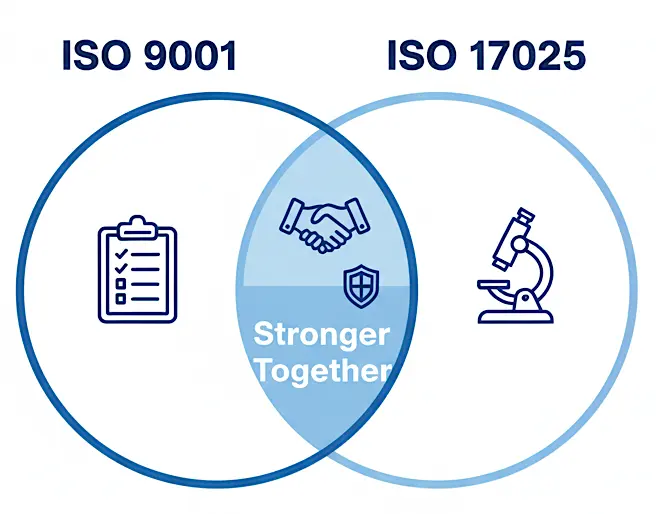
ISO 17025 vs ISO 9001: Core Differences
Although both standards define requirements for quality, their scope and intent differ significantly. ISO 9001 is a general QMS standard. ISO 17025 is a technical competence standard for laboratories.
Here are the most important differences:
Area
ISO 9001:2015
ISO 17025:2017
Purpose
Quality management – customer satisfaction, process efficiency
Technical competence – valid test/calibration results
Type
Certification – voluntary, third-party audited
Accreditation – formal recognition of technical competence
Industry scope
Universal – any organization, any industry
Testing and calibration laboratories only
Key requirements
Document control, internal audit, management review, corrective action
Method validation, measurement traceability, equipment calibration, personnel competence, proficiency testing
Calibration requirements
Requires a calibration program, but no specific methodology
Detailed requirements for traceable, documented calibration, measurement uncertainty
Regulatory acceptance
Accepted for general quality, not for lab results
Required for legally defensible test/calibration results
Should I Get ISO 17025 Accreditation?
Not every organization needs ISO 17025 accreditation. The answer depends on whether you operate a laboratory and whether your customers or regulators require accredited test results.
Your Situation
ISO 17025 Recommended?
Why
Commercial testing laboratory
(provides test results to external customers)
✅ Yes – often required
Customers and regulators demand accredited results.
In-house manufacturing lab
(tests raw materials or finished products)
❓ Sometimes
Required if your customers demand accredited results or you need to defend test results legally.
Calibration laboratory
✅ Usually required
Traceability is critical. Most customers demand ISO 17025 accreditation.
Research & development lab
(internal use only, not regulatory)
❓ Optional
Good practice, but not typically required unless publishing or seeking grants.
Non-laboratory business
(manufacturing, services, IT, etc.)
❌ No – not applicable
ISO 17025 applies only to laboratories. ISO 9001 is the appropriate standard.
The bottom line: If you operate a laboratory that produces test or calibration results for external customers or regulatory purposes, ISO 17025 accreditation is likely required. If you do not have a laboratory, focus on ISO 9001.
Do I Also Need ISO 9001?
Many laboratories ask whether they need ISO 9001 in addition to ISO 17025.
The short answer: Yes, but for different reasons. Unlike AS9100 (which includes ISO 9001), ISO 17025 is a completely separate standard. They complement each other. Here is the distinction:
ISO 17025 ensures technical competence – valid test results, proper calibration, method validation, staff competence.
ISO 9001 ensures management system quality – document control, customer satisfaction, internal audits, management review.
Our advice: Many laboratories pursue both. ISO 17025 for technical credibility, ISO 9001 for overall business quality. Start with the one that matters most to your customers.
Does ISO 9001 Help with ISO 17025?
Yes, ISO 9001 does help organizations achieve ISO 17025 accreditation. Not as a substitute but as a management system foundation that is directly useful for ISO 17025:
Document control procedures
Internal audit program
Corrective action system
Management review process
Training and competence records
Supplier management
However, ISO 9001 alone is not enough. ISO 17025 adds specific technical requirements that ISO 9001 does not address – method validation, measurement traceability, proficiency testing, estimation of measurement uncertainty, and detailed equipment calibration requirements.
Organizations that already have ISO 9001 typically find ISO 17025 implementation faster and less expensive because the management infrastructure is already in place. So, if you are a laboratory starting from scratch, consider implementing ISO 9001 first. It builds the management discipline you will need for ISO 17025 anyway. Then add the technical elements with a specialized consultant.
Integrated ISO 9001 & ISO 17025 Systems
Extending an existing QMS to meet ISO 17025 requirements is straightforward as both standards share the Annex SL framework. Starting with your ISO 9001 foundation you simply add the missing laboratory elements – method validation, measurement traceability, proficiency testing, estimation of measurement uncertainty, and detailed equipment calibration methods.
The result:
One set of procedures (where requirements overlap)
One internal audit program covering both standards
One management review
Two certificates (ISO 9001 and ISO 17025)
Real-World Examples
Let us look at how different organizations approach ISO 9001 and ISO 17025.
Example 1: A commercial environmental testing laboratory
They analyze water and soil samples for regulatory compliance. Their customers (construction companies, government agencies) require ISO 17025 accredited results. They also pursue ISO 9001 to improve their business operations and customer service.
Decision: Both standards. ISO 17025 for legal defensibility, ISO 9001 for business quality.
Example 2: A manufacturing company with an in-house calibration lab
They calibrate their own production equipment. Their automotive customers require ISO 17025 accreditation for calibration. The company already has ISO 9001 for its production processes. They add ISO 17025 specifically for the calibration lab.
Decision: ISO 9001 for the factory, ISO 17025 for the lab.
Example 3: A pharmaceutical quality control lab
They test drug products for release to market. FDA regulations require ISO 17025 accreditation. The company already has ISO 9001 for its overall quality system. They maintain both.
Decision: Both standards. ISO 17025 for regulatory compliance, ISO 9001 for management system.
Example 4: A small machine shop
They make metal parts. They have no laboratory. Their customers care about part quality, not test results.
Decision: ISO 9001 only. ISO 17025 does not apply.
Example 5: A university research lab
They conduct research but do not provide commercial test results. Accreditation is not required, but they follow ISO 17025 as a best practice to ensure data quality.
Decision: ISO 17025 voluntarily for quality improvement.
The difference comes down to whether you operate a laboratory and whether your customers or regulators require accredited results.
Conclusion
ISO 17025 vs ISO 9001 is not about choosing the "better" standard but the right one for your organization.
ISO 9001 improves quality, customer satisfaction, and operational efficiency. It suits any organization, including laboratories as part of their management system.
ISO 17025 demonstrates technical competence and produces valid test/calibration results. It is essential for laboratories that need legally defensible results.
Here are some final tips:
Know your obligations. If you produce test results for customers or regulators, ISO 17025 is likely required.
Use ISO 9001 as a foundation. It builds the management discipline you will need for ISO 17025 anyway.
Do not confuse the two. ISO 9001 does not replace ISO 17025 for laboratory competence.
We hope this guide helps you make an informed decision. For ISO 9001 resources, toolkits, and training, explore our free downloads and learning center.